Almost any organic material is suitable for composting. Your composter or compost pile needs a proper ratio of carbon-rich materials, or “browns,” and nitrogen-rich materials, or “greens.” Among the brown materials are dried leaves, straw, and wood chips. Nitrogen materials are fresh or green, such as grass clippings and kitchen scraps.
Mixing certain types of materials or changing the proportions can make a difference in the rate of decomposition. Achieving the best mix is more an art gained through experience than an exact science. The ideal ratio approaches 25 parts browns to 1 part greens. Judge the amounts roughly equal by weight. Too much carbon will cause the pile to break down too slowly, while too much nitrogen can cause odor. The carbon provides energy for the microbes, and the nitrogen provides protein.
Leaves represent a large percentage of total yard waste. If you can grind them in a gas or electric leaf shredder or mow over them, they will reduce in size making them easier to store until you can use them in the pile, and they will decompose faster – an issue with larger leaves. They are loaded with minerals brought up from the tree roots and are a natural source of carbon. A few leaf species such as live oak, southern magnolia, and holly trees are too tough and leathery for easy composting. Avoid all parts of the black walnut tree as they contain a plant poison that survives composting. Eucalyptus leaves can be toxic to other plants. And avoid using poison oak, poison ivy, and sumac.
Pine Needles need to be chopped or shredded, as they decompose slowly. They are covered with a thick, waxy coating. In very large quantities, they can acidify your compost, which would be a good thing if you have alkaline soils.
Grass Clippings break down quickly and contain as much nitrogen as manure. Since fresh grass clippings will clump together, become anerobic, and start to smell, mix them with plenty of brown material. If you have a lot of grass clippings to compost, spread them on the driveway or other surface to bake in the sun for at least a day. Once it begins to turn pale or straw-like, it can be used without danger of souring. Avoid grass clippings that contain pesticide or herbicide residue, unless a steady rain has washed the residue from the grass blades.
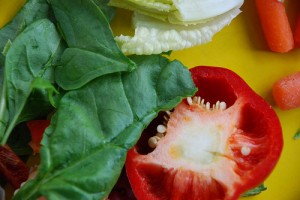
Kitchen Refuse includes melon rinds, carrot peelings, tea bags, apple cores, banana peels – almost everything that cycles through your kitchen. The average household produces more than 200 pounds of kitchen waste every year. You can successfully compost all forms of kitchen waste. However, meat, meat products, dairy products, and high-fat foods like salad dressings and peanut butter, can present problems. Meat scraps and the rest will decompose eventually, but will smell bad and attract pests. Egg shells are a wonderful addition, but decompose slowly, so should be crushed. All additions to the compost pile will decompose more quickly if they are chopped up some before adding.
To collect your kitchen waste, you can keep a small compost pail in the kitchen to bring to the pile every few days. Keep a lid on the container to discourage insects. When you add kitchen scraps to the compost pile, cover them with about 8″ of brown material to reduce visits by flies or critters.
Wood Ashes from a wood burning stove or fireplace can be added to the compost pile. Ashes are alkaline, so add no more than 2 gallon-sized buckets-full to a pile with 3’x3’x3′ dimensions. They are especially high in potassium. Don’t use coal ashes, as they usually contain large amounts of sulfur and iron that can injure your plants. Used charcoal briquettes don’t decay much at all, so it’s best not to use them.
Garden Refuse should make the trip to the pile. All of the spent plants, thinned seedlings, and deadheaded flowers can be included. Most weeds and weed seeds are killed when the pile reaches an internal temperature above 130 degrees, but some may survive. To avoid problems don’t compost weeds with persistent root systems, and weeds that are going to seed.
Spoiled Hay or Straw makes an excellent carbon base for a compost pile, especially in a place where few leaves are available. Hay contains more nitrogen than straw. They may contain weed seeds, so the pile must have a high interior temperature. The straw’s little tubes will also keep the pile breathing.
Manure is one of the finest materials you can add to any compost pile. It contains large amounts of both nitrogen and beneficial microbes. Manure for composting can come from bats, sheep, ducks, pigs, goats, cows, pigeons, and any other vegetarian animal. As a rule of thumb, you should avoid manure from carnivores, as it can contain dangerous pathogens. Most manures are considered “hot” when fresh, meaning it is so rich in nutrients that it can burn the tender roots of young plants or overheat a compost pile, killing off earthworms and friendly bacteria. If left to age a little, however, these materials are fine to use.
Manure is easier to transport and safer to use if it is rotted, aged, or composted before it’s used. Layer manure with carbon-rich brown materials such as straw or leaves to keep your pile in balance.
Seaweed is an excellent source of nutrient-rich composting material. Use the hose to wash off the salt before sending it to the compost pile.
The list of organic materials which can be added to the compost pile is long. There are industrial and commercial waste products you may have access to in abundance. The following is a partial list: corncobs, cotton waste, restaurant or farmer’s market scraps, grapevine waste, sawdust, greensand, hair, hoof and horn meal, hops, peanut shells, paper and cardboard, rock dust, sawdust, feathers, cottonseed meal, blood meal, bone meal, citrus wastes, coffee, alfalfa, and ground seashells.
I have been searching all afternoon for items that can be composed. Your sight is very helpfull and gave me many more ideas and suggested avenues to make compost for my large vegetable garden and my multiple flower gardens. I detest chemical applications of pesticides and fertilizers.
Do you have any recipes for natural pesticides and weed prevention or killing.
I have had difficulty with deer in my gardens and found that if you apply some cyan pepper to plants it discourages the nibbling.
If you have any more ideas, especially to prevent worms and diseases on fruit trees. I do not want to use pecticides that are dangerous and I several apple trees that supply fruit for me, but many other family members, friends, and neighbors. Whatever info you have would be greatly appreciated as well as shared with many other gardeners.
Thank You,
Rose Day
@Rose Day,
I have found this site to be useful in regards to your questions; they have several products that should help.
http://www.cleanairgardening.com
how about kitchen leftovers? can we use it as compost materials?. thnaks
@tito azura,
Kitchen leftovers generally do not make good compost material, however fruit and veggie scraps do.
You never want to add meat or dairy. I suggest you throw out the leftovers and stick to only composting fruit and veggie scraps, the others will attract rodents
We just had a beehive composter built. We don’t quite know where to start with it. It’s really cute, because I can blend it right into my garden just outside my door, making it more usable on a daily basis. But, we don’t know if we just start dumping things in there or if we should have a screen so things are not dumped right onto the ground. And, second, can you compost over the winter? My husband says no, but I lice in New England. If it takes 6 months to make compost, we barely have enough time here to do so in one year! What do you do if it gets too cold and the compost is not done? Thanks for the answers.
@wendy,
In my opinion composting is not an exact science, it takes trial and error. Start adding to it right away. You can put just about anything with the exception of meat, bones and dairy. Below is a link to see what you can compost. You don’t necessarily need a bottom to it, just put it on dirt or grass, and you will find that earth worms will make their way into it and the nutrients from the compost will just drain down into the ground.
Ideally you want it as warm as possible, so try to place the composter in the sunniest spot you can. As for your short season, your compost will slow down in the cold and pick up when it gets warmer. Maybe it will take longer to compost then normal, but it will eventually break down. Keep it moist with a good mix of brown and green and you will be fine. Here is that link.
https://www.compostguide.com/composting-chart/
I live in florida and have mostly pine trees and oak trees available. Are these suitable for compost? Thank you.
@Dick,
Yes, both will break down; however the pine needles will take the most time. You can speed up the process but making sure you both chop and/or shred them as much as possible, and have a good mix of nitrogen rich material, like kitchen scraps. If you don’t have a shredder you can use a mower with a bag.
While everything else in your pile might break down in 4 to 8 weeks, the pine needles may take 3 to 4 times longer. The leaves on the other hand will do will, go ahead and shred them too.
Remember composting is trial and error, one time it might not go so well, so try a different mix and see how it goes. It will all break down eventually, we are just speeding up the process by creating the ideal conditions.
Hello World, our question is, we do a lot of melons rines
And they create a lot of mosture and some SMELL is there
something we can use to keep the smell down,
Thank You
I AM Ken
@Ken Klingbeil,
Make sure they are buried well in carbon rich items such as dried grass clippings and leaves. This will cut down on the smell and make for much faster decomposition.
How about fish manure? When I clean the fish tank, it usually goes down the drain, can this be used in a compost pile, will it add value or remove it?
@Bill, I don’t think it will be a problem, however it might smell. Give it a try and see what happens. Worst case you lose a batch of compost but I suspect if you can handle any odor it will benefit your pile.
This site is Heaven sent I have been searching for this kind of information. I am really excited now and I feel so much more
informed. Thanks so much.
Lorraine from Glendale, AZ
@Lorraine Burch, We are glad it was helpful. Happy Composting!
Great article. I learned so much just from the above info. Just starting my first compost pile for my veggie garden and am very excited to get it going for next springs planting.
@nance95661, Thanks for your comments, don’t give up if you first attempt does not go as well as you plan, its trial and error for beginners and even pro’s can have a bad pile. Happy Composting!
Is it okay to put spent carbon from the water filtration system into the garden or compost? If so , how much is recommended? Thank, you
@mike peters, Yes, you can add the spent carbon from your water filtration. Treat it as any other carbon, which should be the bulk of your compost material.
Thanks for an informative website! My question is: Can we compost the “gum balls” from our prolific gum trees? They don’t break down well on their on in the lawn.
@Lonna, Yes, they will break down however they will likely take longer than most other items.
when using shreaded paper in compost, what proportion do you use?
@michael, You always need a good mix of browns and greens, browns being carbon and greens being nitrogen. The paper is a brown/carbon. The majority of the mix should be browns at roughly 75% and the remaining 25% should be greens. The problem you might have it the paper balling up when wet, so try to mix in some other browns like dried leaves or dried grass.
I don’t have any brown stuff only lots of grass clippings,what do i use for brown stuff?
Kent
@Kent Bybee, Dry out the grass clippings and you can use those as browns. Also, if you have access to any newspaper, you can use it. Make sure you shred before adding it.
You may also want to consider switching to vermicomposting, no browns are needed.
Here is a great worm composter: http://www.cleanairgardening.com/wormcomposter.html
Our condo association is going to start using a composter in our back yard in a couple weeks. What do I need to get started? We use a mulching mower right now, so glass clippings will be hard to come by. Are there any starter materials that I need to buy? We are looking at the soil saver backyard composter.
Thanks!
@JJ, You will need to start with a good bin, depending on the amount of material you may need several bins or one large bin, like this one: http://www.cleanairgardening.com/wirecompostbin.html
You will need to start with a fair amount of leaves (browns or carbon), then mix in your greens (nitrogen), layer them with the bulk being the browns.
Make sure you add plenty of water. Here is a good list to reference: https://www.compostguide.com/composting-chart/
Can you use Newspaper and copy paper that has ink on it?? Or will the ink leach and cause problems in my Veggie Garden when I use the compost??
@Chuck, Adding newspaper and copy paper with ink on it to your compost bin should not cause any problems to your vegetable garden. The amount of ink is negligible and the heat and composting process will neutralize it.
What can you do if ants infest your compost?
@Debbie Gordon, If your compost has been infested with ants there is a good chance it’s to dry, try keeping it as moist and a wrong out sponge. Keep in mind ants are not all bad; they help aerate the pile and transfer good minerals between destinations. Keep it aerated (mixed) and moist and you should run them off.
Can you tell me if citrus fruits are ok to compost? Lemons, limes, grapefruits etc. I think not, but my husband keeps putting the skins in and they never seem to rot down
Carole, Yes, you can add them but as you have seen they take much longer to break down. Not knowing the ratio of citrus to other items, I would be sure to make it a very small percentage, like less than 10% of the amount of greens added. And the amount of greens should only be about a third of your overall mix.
Can I add shredded white paper to my compost? The white paper is office trash paper with different colored ink.
@RM Bishop, Yes, adding this paper is fine, I suggest shredding it to help speed up the process and make sure its moist. Count white paper as a carbon, so be sure to have a small amount of nitrogen added.
I have a large amount of coffee grounds. What flowers and vegs can I use them on?
Thanks
@Ray,
Yes, you can use coffee grounds to plants that like acidic soil, like azaleas, rhododendrons, blueberries, etc. Coffee grounds are also great for your compost bin, plus you can throw in the filter.
My husband has just started woodworking, and I was wondering how to use the sawdust in composting.
@Lauren, Sawdust is great for composting. Count it as a carbon, remember for the best composting there should be a ratio of roughly 3 to 4 parts carbon to one part nitrogen. Keep your compost as moist as a well rung out sponge and aerate it weekly.
I was told not to use old hay as the seeds will sprout and will have these in your compost. Should only use materials that do not have seeds, ie grass clippings, leaves. Is this true?
If your pile is built properly and heats up and the temperature is usually enough to “cook” the seeds and stop them from germinating. even if they do sprout , when you turn your compost they will die and add to your compost.
Can I put in small twigs that fall from the trees along with the leaves? Do I need to break them into small pieces?
@Alice M
Yes, as long as you don’t overload it. Twigs break down slowly, but it’s okay to have a few not quite decomposed ones in your finished compost for texture anyway. When you break them into smaller pieces, they will break down faster and better. But it might not be worth the additional work.
My question is how do you decompose an apple cause we got an project so like we have to build a composter to decompose the apple. By the way the info helped a little thanks,
We have about 20 chickens and wonder if the mixture of chicken manure, straw and uneaten food would be good to add to our existing pile?
@Roger
Yes, absolutely. Chicken manure is very nitrogen rich and heats up compost quickly. Straw balances that out pretty well, and the other stuff is fine too. If you’re adding it to other compost ingredients, you should do well with it.
I can’t get my pile above 60 deg., even though I think I have a good mix and turn the pile every few days. Now we are going into winter and snow. What to do?
Pullman, WA
@Roger, Try adding some Cottonseed meal or coffee grounds, I’m guessing you need more nitrogen. Also try waiting a little longer to turn it, maybe only if it gets 80 to 90 degrees. As for the winter coming, not much you can do there, just cover it and wait for spring.
We have a local winery that gives away what remains after the juice is squeezed out of the grapes. Good compost material?
good day!
i just wanna ask if a overdue compost still be good?
what do I do if it already has worms?
thank you!
@ronalyn, No compost does not go bad, and if it has worms all the better. Add the finished compost to your garden, shrubs or lawn and enjoy.
Your site is the most informative one I’ve yet to come across. Thank you so much for taking the time to educate us. I have aquestion regarding very rotten osage apples and the water they’re rotting in. I forgot about them this past fall and they are truly disgusting. Can I still safely add them to my compost pile ?
@jl Li, Yes you can add rotten fruit to you compost bin, however make sure you add at least twice as much carbon material, like leaves, shredded paper, dried grass clippings, etc.
I am just in the process of buying a composter but I’m at a loss. I live in a small condo with only a few potted plants to really work with but Id like to reduce my garbage haul. Any ideas or recommendations as to what I can do with my compost and what a good composter would be with little room. I have some room on our patio but we r on the 4th floor. Thanks!
@Cody, I strongly suggest trying vermicomposting, i.e. with worms. The worms will break down your kitchen scraps and a small amount of paper towels. Here is a link to a worm bin, or you can make your own out of plastic bins. Its great fun and the worms make great pets.
http://www.cleanairgardening.com/wormcomposter.html
HOW LONG DOES IT TAKE TO MAKE COMPOST MATERIAL
@DAVID, In ideal conditions and with the right combination of browns and greens you can compost in a month or two. I’m a lazy composter so it takes on average of about 6 to 8 mths. By lazy I mean I don’t turn it often, I just keep adding to it and let it break down when it wants to, haha.
Can the used bedding from a chinchillas cage be added to my compost bin? I am guessing if so it would be counted as carbon.
Thanks for the great website! It has been a great help.
@Trina, Yes, you can add chinchilla bedding to your compost and yes for the most part its carbon, the droppings would likely be nitrogen but in such small portions it’s not going to amount to much.
Thanks Steve! I have been short on carbon for my compost bin, then the chinchilla bedding came to mind. Problem solved!!
Hi,
I noticed the hops as a nitrogenous addition to compost but does this need to be used hops or can fresh cut hops be added? We have a hops plant that I could use but when I was reading other websites on composting everything mentions “used hops.” Is there a difference or can I use dry clippings?
Thanks!
@Tess, Either will work for composting fresh or dried hops. I would think the dried hops would be more of a carbon and fresh would be more of a nitrogen.
Can I use fresh rubarb leaves in my compost if they are shredded? Rubarb leaves are very toxic if eaten, and have always been told to wash good after handeling them.
@Dan Rauschenberg, Unless you plan to add a large amount of rhubarb leaves the toxicity should be lowered when blended with the other compost ingredients. Once broken down even if the compost is eaten, which I don’t recommend, the toxins in the leaves will have been neutralized.
Hi, wanting to know if it’s safe to add wisteria leaves to the compost for my vege garden, as I understand that they the plant is toxic, even not recommended to burn.
Irene, If you like wisteria and don’t mind the chance of spreading it go ahead and compost it. As for it causing a problem with some toxins, I doubt it will actually cause a problem.
Hi, I am starting a composter, but I am wondering about composting my cat litter. We have 2 cats, 1 hamster. I am going to use the hamster shaving to compost but can I use the cat litter and how would I incorporate the cat litter in the compost a safely for my garden (fruits and veggies).
@Leslie, Using the hamster shavings is ok, but do NOT use cat litter, there are pathogens that are not healthy for the elderly, small children and pregnant women. Also, its just not a good idea to compost animal droppings that eat meat.
thats cool i never new that i could have been using my grass cuttings for years but i didn’t i would just cut the grass and leave it i do do and use all thats written on this website the only thing that i haven’t never used is grass clippings i have used cow poop before and for this year for my garden im using cow poop and tree stump dirt & i would say don’t have the compost bucket in your house because it attracts way to many fruit-flies even if you cover it you’ll still have fruit flies like i do and i put my egg shells in a grinder and grind them up into powder
oh yeah and is horse poop any good or is it some what like using cow poop
i wouldn’t use any cat poop or litter
@Mike, Thanks for your comment. Yes, grass clippings are great for composting and as you suggested so are cow poop and horse poop. As for kitchen scraps, there are several containers kitchen scraps can be kept in to keep the fruit flies from being a problem. Also, if the kitchen compost pail is dumped every few days it’s never a problem. Kitchen scraps are far to great of a compost resource to have to not take advantage of them. For those who do not like going to the compost bin every day to dump them a counter top pail is a life saver.
Great Chart – Thanks
We have a vegie garden attached to a “Soup Kitchen” type environment. What about:
1) Soup leftovers?
2) Lots of bread?
3) If we can control vermin is meat, meat fat and cooking oil ok?
Unfortunately, we cant have chooks to process the above for us.
@John, You can compost all these things you listed but its likely going to turn into a big mess. You would need alot of carbon to balance it out. Typically you mix 4 parts carbon (browns) to 1 part nitrogen and you have listed mostly nitrogen, except for the bread. Even if you keep out the vermin the mean and oils will likely stink really bad. I strongly suggest you don’t try composting meat and cooking oils.
Thank you for so much information. Have a question if you have a moment. Do you know what might happen if I compost wet coffee grounds on its own without brown stuff and in an airtight plastic box which gets lots of sun. It’s been 3 weeks so far and while slimy, it actually doesn’t smell bad yet. I could live with it smelling like vingear but am afraid it will be bad for the plants. I can’t find brown stuff unless I start shredding paper and for now I can’t find the time. Grateful for pointers or a shout that I should just dump the experiment.
@Kit
If you are trying to compost coffee grounds alone, you’d be better off burying them someplace, or using them as a mulch for something like your shrubs, rather than putting them in a plastic box.
http://www.seattlepi.com/lifestyle/homegarden/article/Give-your-garden-a-jolt-with-coffee-grounds-1126438.php
Thanks for the tip but unfortunately I presently live in Hong Kong where mulching if wet tends to cause my herb plants (grown in a flat indoors – yes, I am being a bit silly) to root rot – or at least I suspect it is the case because the plant dries and dies over the course of a few days and the potting soil is entirely covered with mould. The weather in HK is tragically not the best for herb planting in the first place due to humidity and non constant sunlight.
I was hoping to compost the coffee grounds to get nitrogen into the ground while avoiding herb death due to the soil humidity caused by mulching. Is it something that I really should not do vs is a much harder way to get nitrogen into the plants?
Many thanks for your time.
can you put fish into an organic compost pile?
@gina, Yes, you can put fish in your compost bin however be prepared to attract critters so either bury it deep within the pile or make sure you have a closed bin. If it does not get hot enough it may not completely break down or will take a while which is the reason most people do not add meat to compost bins. Also, it can cause a stink.
Hello, I just started to the composting way; doing research left and right. But it seems I just need to find your post, haha. I do want to know, can I put COOKED veggies, rice, yam peels and such down the bin (well, bucket, it don’t cook too well and it is just bearly starting)? Because I got a earful from a friend saying oh it’s just trash there no use doing that, since cooked food lost its nutrient.
@Yue, Yes, you can compost cooked vegetables.
Hi, I use a plastic laundry tub with an old garberator installed in the drain, a plastic pipe goes from the garberator into a hole in the side of a black composter. We named the set up, Darth Vader. ( My hubby ran water & power to the RV shed beside the garden) I grind up all the kitchen scraps ( NO pits!! they choke Mr Vader) I also use a paper shredder. I run a small stream of water thru the garberator as I push the kitchen scraps thru. It makes the compost too wet but it seems to recover quickly. I stir it up and add soil to cover the newly add mush. It all composts very quickly. I do NOT put carrot greens, or tomato vines ( anything stringy) thru the garberator. My questions: Can I put chopped tomatoes vines directly into compost? What about rhubarb leaves? Great site, thank you!
@Maizie, Wow, being a huge Star Wars fan, just the sound of using Darth Vader for anything other than death and destruction is a winner. Yes, you can compost tomato vines but be sure to cut them up as much as possible, otherwise it will take too long to break them down. Also, there is no problem using rhubarb leaves even though they are considered toxic they will not hard your compost.
Your site is very helpful. My question: I understand black walnut leaves and twigs are not good for compost. What about pecan leaves and twigs , as they have a similar smell and texture (I have 3 huge pecan trees in my yard)? Thanks a lot for all the info
@David, You will likely have trouble breaking down the pecan leaves and twigs but if you shred them it should help. Try a few handfuls first and see how it goes.
Hi there~ I’ve been composting for a couple years now and as you have mentioned, trial and error is definitely part of the learning curve when it comes to getting it “just right” for you and what is readily at your disposal. I’ve recently been experimenting with hot composting, as I have an increased need for additional compost since I have expanded my garden and went to a raised square foot gardening approach. I have found that using a very diversified group of browns and greens has given the overall quality of my finished compost a ten-fold increase in the nutrient value for the vegetables. My question is in regards to a new source that I have access to, but have never really given much thought until reading your response to someone regarding using seaweed. I know seaweed has tremendous nutritional value, especially with trace elements, and your comment mentioned it was a wonderful addition, just to make sure that you rinse it off to flush the salt off. I live in central Indiana, no ocean is remotely close, therefore, no seaweed; however, I live on a small lake/large pond and although usually there isn’t any significant surface algae/weeds, I believe due to the significant drought we are experiencing this year there has been an increase in some of these weeds, especially back in the coves where the water fountains don’t keep the water moving as much and where the water is a little more stagnant. I’m assuming that this source would be suitable for a nitrogen source as well, but not having seen or heard anyone using it before I thought I would get your response before I would decide to use it. I know that there are no chemicals added to the pond for water clarity or to keep the weeds down. The neighborhood committee had a meeting discussing the possibility of using such chemicals, but I spoke up and suggested adding a few more aerotors and fountains to keep the water moving and had 4-5 grass carp fish purchased to keep a more natural approach to keeping that weed issue at bay. The lake has no natural water source that feeds into it, just rain that falls into the lake as well as runoff from the houses and lawns that are buyilt on the lake. I know that some houses on the lake have their yards chemically treated and I am not sure how much of a problem that may pose in regards to using the surface weeds from the lake. The lake is approximately 20 acres and their are only about 15 houses that have lake front property, the back half of the lake is just grassy meadows and then a dam that drains any excess water into the small river that runs through town. Sorry for such a lengthy post for a relatively short question, but I wanted to be sure that you have as much information about any and all variables that may play a factor in your response. Thank you in advance for your time and attention to this matter and keep up the excellent work and helpful replies to everyone’s questions concerning composting…truly nothing better for your plants than good, quality compost!!
@Craig, Yes, you should be fine using the lake algae and weeds, give it a try and see how it goes.
Hi, I used Milfoil (aquarium plant), a noxious weed introduced to Okanagan Lake. It is harvested to keep it under control. It made a very nice light, non conpacting, topping on the garden, weeds were easy to pull, the few I had. Love to get some more.
Hi there- This site is great. Can you confirm that onions, tomatoes, and mushrooms are OK to put in with other veggie scraps? I’ve heard that they might not be, but I already threw some in when we started. I don’t see any veggies mentioned here as a no, but just want to make sure. Thanks so much!
@Jamie, Yes you can compost those items however the acidity will likely slow the compost down, so add plenty of browns and maybe some lime (the white powdery substance not the fruit) to neutralize the acid from the tomato.
Hi, I would like to know if brined and processed vegetables specially cucumbers, that are rich in Nacl and acids can be composted ??? We in our processing plant come across huge quantities of fresh cucumber waste and processed cucumber wastes. We are looking for a suitable method to compost them so that we can make use of them at our farms. Kindly let me know if possible.
Thanks.
@Suresh Sivasamy, Yes you should be able to successfully compost the cucumbers if you are sure to add plenty of browns and some lime to neutralize the acidity.
@Steve, Thank you for replying to my query. Coconut thatch and coir wastes are locally available for us. Besides paddy straw is also available. So can we use those materials as browns ??? What kind of layers can be made with the greens and browns ??? Do you think if any other specific materials can be added ??? Kindly let me know as how to calculate the amount of lime that should be added to bring down the acidity based on the pH of the cucumbers.
Thanks.
Hi,
I live in Puerto Rico and live on some land where I have a TON of grass that grows rapidly. My mother in-law has just recently tried cutting some of the grass. She had just left it on the lawn and the grass is now just dried and browned. We also have lots of leaves from an Indian Almond tree that always drops its leaves everywhere and its fruit. We also have many bread fruit, coconut trees, plantain, and west indian cherry trees. All the trees drop leaves all over and the plantain trees fall to the ground sometimes. Would it be okay to add all that to a compost and what would be considered brown or green to the compost pile? We also have lots of ants and cockroaches would those be a threat to a compost pile or are they beneficial?
@Faith, I suggest you find an area away from your home or other living area and make it your designated compost area. Add all the material you have described and keep it aerated (mixed) and moist as a well rung out sponge. The ants are typically considered good because they will aerate the compost but the problem is you will likely spread them when you spread your finished compost. I imagine you will see less of them in your compost when you aerate your compost regularly. The roaches can be a problem but there are some organic methods you can try to get ride of those, as well as aerating might drive them away. It sounds like you will have more browns than greens so try to add some coffee grounds (green) and kitchen veggie scraps as often as possible.
I have 2 buckets of all nitrogen sources–kitchen scraps mostly…and they have unfortunately been sitting for months now. I am quite scared to open the buckets but I figured once I get past that–I can mix loads and loads of carbon sources (mainly newspaper) in with the stuff.
Is it too late to do such a thing? What are my chances of ending up with a quality compost now that I have a stew of nitrogen waiting to be mixed in with carbon? Thanks.
I just bought a compost tumbler, and was wondering if turning it every day is good or bad, or should I just turn it once or twice a week. Thank you!!!
thanks for the info very helpful needed it for a class project
I have a few haybales, who had been dumped in a pile. While working on my composting bins en wanted to use that rotten hay I had the idea that this was a bonus, sinse de composting had already started.
I am however not sure if this stuff in this condition, is a “Green” or a “Brown” in the context of “the right ratio”.
Greetings
Jelte
Found your examples of “greens” to be very helpful. I have lots of brown but little green. Thanks so much for your post!